
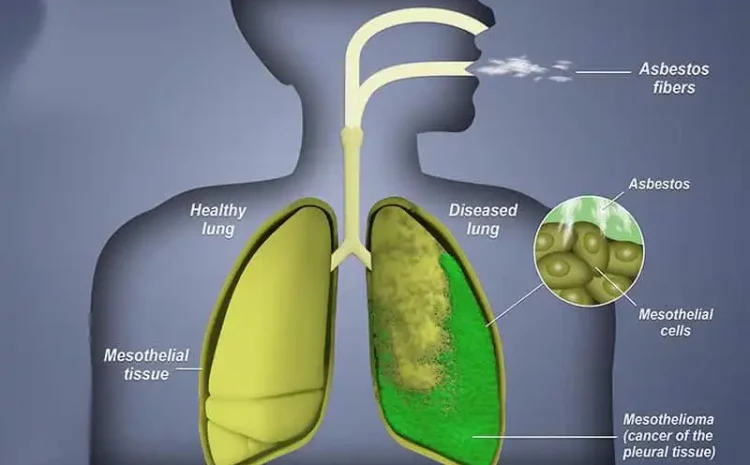
For decades, builders celebrated asbestos as a “magic mineral” because it easily resisted fire and extreme heat. Construction crews packed it into the walls of our homes, schools, and workplaces without a second thought. But underneath that widespread praise hid an invisible threat that would eventually upend millions of lives.
Unlike ordinary household dust, this mineral breaks down into remarkably jagged pieces. Think of asbestos as a microscopic splinter. Once breathed in, these tiny, needle-like fibers embed themselves deep inside the lungs, and the human body simply cannot wash them out or remove them. Over time, that constant physical irritation creates heavy internal scarring and severe health problems.
Did you work in a shipyard or install insulation thirty years ago? According to medical researchers, the “latency period”—the long, quiet delay between breathing in those fibers and actually feeling sick—can last anywhere from 20 to 50 years. This massive time gap perfectly explains why so many retired tradespeople are only just now experiencing serious occupational asbestos exposure symptoms.
Companies understood these devastating health risks for years but purposefully chose to keep them secret from their workers. Today, confronting asbestos exposure risks with asbestos claims law is the most direct path to securing the medical care and financial help you deserve. Billions of dollars have already been set aside in specialized trust funds to protect families navigating this sudden, heavy burden.
Identifying the ‘Invisible Threat’ in Your Past: Common Job Sites and Residential Risks
If your home was built before 1980, or if you worked in heavy industry decades ago, you might be living with a hidden intruder. Because this mineral resisted heat and fire, companies packed it into everyday products. It sits quietly behind walls and under floors, posing little danger until someone starts tearing it out during a renovation.
The true risk unlocks through a property called “friability.” This is simply the tendency of an aging material to crumble into powder when touched or damaged. When these materials become friable, they release microscopic splinters into the air that the body cannot remove. When identifying asbestos in residential properties, always follow the “Don’t Disturb” rule: if an old material is crumbling, do not sweep or touch it, and hire a professional to test it instead.
Knowing where this threat hides can protect your family today. Be cautious around these five common household materials and three top asbestos-contaminated job sites:
- Popcorn ceilings, vinyl floor tiles, textured wall paints, basement pipe insulation, and older attic insulation.
- Shipyards, power plants, and active construction zones.
Even if you never worked directly with these materials, carrying dusty work clothes home could have put your family at risk. Sadly, early occupational asbestos exposure symptoms—like a lingering cough or mild shortness of breath—are incredibly easy to brush off as simple aging. Since these fibers remain dormant in the lungs for years, protecting your health and legal rights today means examining the specific impacts of asbestosis and mesothelioma.
The Decades-Long Wait: Asbestosis vs. Mesothelioma Legal Rights
Many former tradespeople feel perfectly healthy today, completely unaware that microscopic fibers are still trapped inside their lungs. Because of the decades-long gap between exposure and illness, early occupational asbestos exposure symptoms like a persistent cough or breathlessness often get dismissed as simply getting older, allowing the damage to worsen unnoticed.
When doctors finally spot the damage, patients usually face one of two main diagnoses. Asbestosis is a chronic inflammation and scarring of the lung tissue caused by those stubborn fibers, whereas pleural mesothelioma is an aggressive cancer attacking the protective lining of the lungs. Navigating asbestosis vs mesothelioma legal rights comes down to the severity of the illness; while both conditions prove companies failed to protect their workers, the justice system treats them differently.
Securing your family’s financial future requires addressing these legal distinctions, as malignant mesothelioma diagnoses automatically qualify for higher compensation tiers from established trust funds. The law ensures money is set aside to cover steep medical bills and provide peace of mind. Unfortunately, this danger wasn’t confined to industrial job sites, making it vital to explore the impact of secondary exposure and liability.
Bringing the Dust Home: Understanding Secondary Exposure and Liability
For decades, spouses washed dusty work overalls and children hugged their parents after a long shift, unaware that the invisible threat of asbestos hitched a ride home on clothing and hair. Because these microscopic splinters easily transferred into household air, family members often develop the exact same warning signs—like a nagging cough or shortness of breath—years after living with an industrial worker.
The tragedy of this “take-home” dust is that employers knew the danger but failed to provide on-site showers or protective warnings. This negligence created direct secondary asbestos exposure liability for those companies, meaning the law holds them fully accountable for a sick spouse or child. Family members who never set foot in a shipyard or factory have strong, recognized legal rights when corporate carelessness invades their homes.
Navigating a family illness feels overwhelming, but specific provisions for asbestos victim relief exist to help cover your medical bills and secure your legacy during this difficult time. Because the legal system recognizes this immense burden on unsuspecting families, you rarely have to endure a lengthy trial to get support. Instead, many victims find their path to financial peace of mind begins with the billion-dollar safety net of asbestos trust funds.
The Billion-Dollar Safety Net: How Asbestos Trust Funds Work
When the devastating health impacts of the “magic mineral” surfaced, negligent corporations filed for bankruptcy to avoid facing families in court. However, going out of business did not let them off the hook. Federal courts forced these companies to put billions of dollars into permanent safety nets known as asbestos trust funds to help future victims.
Securing financial help through these trusts involves an administrative claim, which completely skips the dramatic courtroom battle. Consider this three-step comparison between the two paths:
- Process: Lawsuits rely on trial-based battles, while administrative trust claims are handled quietly by a review board.
- Speed: Traditional litigation can drag on for years, whereas trusts offer faster financial relief without court dates.
- Proof: Instead of testifying against corporate lawyers, you simply submit medical and exposure records.
Successfully filing an asbestos trust fund claim relies on accurate payout calculations. To ensure money remains for future victims, boards use “Trust Fund Liquidation,” meaning they pay a fixed percentage of your total claim value so the safety net never runs empty. These scheduled percentages provide reliable support for medical bills and make up a vital portion of the average settlement for asbestos-related diseases.
Ultimately, this court-ordered system allows you to protect your family’s future without the crushing stress of a lawsuit. The money is already waiting for those who qualify. Your most important next step is simply protecting your right to claim it by acting within the statute of limitations.
Navigating the Clock: The Statute of Limitations and Legal Timelines
The strict legal deadline to file a claim is called the statute of limitations. Because asbestos fibers can sleep in your body for up to fifty years, the law uses a protection called the “Discovery Rule.” This means your countdown does not start the day you inhaled the invisible dust decades ago. Instead, the clock officially starts the day a doctor gives you a diagnosis, ensuring you are not shut out of the mesothelioma legal compensation process before you even know you are sick.
Every state sets its own rules for this timeline, typically allowing between one and three years to act. The statute of limitations for asbestos lawsuits applied to your specific case is not always tied to your current address. Your filing window might legally follow the laws of your present home, the state where you worked construction decades ago, or even the state where the responsible corporation is headquartered.
Certain unique circumstances can also temporarily pause, or “toll,” this countdown to protect your rights. For example, if an exposed loved one passes away, the clock often resets, giving grieving families a fresh window to seek help. Beating this deadline relies entirely on proving when and where the harm occurred, bringing us directly to the crucial step of documenting your exposure history.
Evidence for Empowerment: Documenting Your Exposure History
Proving you were harmed by this microscopic intruder starts with the right paperwork. When assembling the medical evidence needed for asbestos claims, a standard doctor’s note is not enough; you need “pathology confirmation.” This is simply a specialized lab report where a doctor examines tissue samples under a microscope to officially confirm a disease like mesothelioma. Once your health is properly documented, the focus shifts to tracing that illness back to the source.
Many families facing this diagnosis naturally wonder, “can I sue my employer for asbestos exposure from thirty years ago?” The answer is often yes, but it requires occupational history reconstruction—a formal way of rebuilding your past work life. You do not need a perfect memory to succeed here. By compiling a detailed Work History Log, you can identify the exact job sites, shipyards, or home renovation products that put you in danger.
Fortunately, official paperwork leaves a permanent trail even when memories fade. To build a solid foundation for your claim, focus on collecting this specific checklist of documents:
- Pathology reports: To legally confirm your medical diagnosis.
- Work history logs: To track your daily duties and exposure timelines.
- Social Security Earnings Records: To prove exactly who paid you and when, which is crucial if the company later went bankrupt.
- Union records: To verify your specific trade assignments and dates.
With this history clearly established, you can move forward with confidence to secure wrongful death or veteran benefits.
Securing Your Legacy: Wrongful Death and Veteran Benefits
When an illness progresses quickly, families often fear their chance for justice is lost forever. Fortunately, the legal system provides a vital safety net for grieving relatives. Through asbestos litigation for wrongful death, surviving family members can step directly into a loved one’s shoes to finish an existing case or start a new one. This successor protection ensures that compensation set aside by negligent companies still reaches your household, securing your family’s financial future even after a loss.
Military members who encountered this microscopic intruder have an additional, parallel path to security. The government offers specific compensation if your illness traces back to your military duties, a standard known as “VA Service Connection.” Pursuing these veterans asbestos exposure benefits is completely safe for your legal standing. Receiving this monthly government support never limits your right to simultaneously file private claims against the bankrupt manufacturers who originally supplied those toxic materials to the military.
Realizing these dual safety nets exist instantly removes the heavy burden of wondering how to support your survivors. With your history documented and your options clear, you are ready for the final step of following your action plan.
Your Action Plan: Moving from Uncertainty to Empowerment
The invisible threat of asbestos is no longer a mystery you must navigate alone. You now understand that the microscopic fibers you may have encountered decades ago have a clear, structured path to a financial remedy today. Seeking this compensation is your rightful step toward security, never a burden on your family.
Because legal teams in this field operate on a “No Win, No Fee” basis, you can seek justice without any upfront costs. Take control of your situation using this simple ‘First Week’ checklist:
- Confirm diagnosis: Gather your official medical records.
- Map work history: Write down your past employers and job locations.
- Consult a specialist: Focus on finding a specialized mesothelioma lawyer.
- Check eligibility online: Safely explore your available legal options.
You no longer have to carry the weight of medical bills and uncertainty in the dark. Protect your family’s legacy and explore your available legal options at Railroad Asbestos Claims.
See if you qualify for compensation
Sammons & Berry, P.C.
800-519-1440
View our Google Listing